Showing posts with label Grand Traverse Pebble Pups. Show all posts

Saturday, September 12, 2026

Unlocking the Secrets of Anyolite!

By Broden Dymond

Have you ever seen a rock that looks like it has a ruby hidden inside it? If you have, you might have seen anyolite! Anyolite is a metamorphic rock made up of three different minerals: zoisite, ruby, and sometimes amphibole. It is also known by its trade name, “ruby in zoisite.”

Figure 1. Anyolite from Mundarara Mine, Tanzania. Red colored ruby inclusions are visible. Specimen on display at the Idaho Museum of Natural History, Pocatello, Idaho. Photo source Wikimedia Commons.

The Discovery and Trade of Anyolite

Anyolite was first discovered in 1954 in Longido, in northeastern Tanzania. The mine where it was first discovered is still in use today, and anyolite is still exported from Tanzania.

Anyolite is also used in artwork and decorative items. It can be made into sculptures, figurines, ornamental objects, and jewelry designs. Some people also use it in meditation practices because they believe it can help relieve stress and support emotional healing.

But be careful! There is a similar-looking mineral called ruby in fuchsite that can be confused with anyolite. One way to tell them apart is with a hardness test. Fuchsite has a hardness of only 2–3.


The Geology of Anyolite

Anyolite is a metamorphic rock, and it usually has a Mohs hardness of 6–6.5. It contains three minerals that give it an interesting appearance.

The first mineral is zoisite. Zoisite contains chromium, which causes its vibrant green color.

The second mineral is ruby. Ruby is made of corundum crystals, which are a crystalline form of aluminum oxide. The ruby is what makes anyolite especially interesting because the bright red ruby crystals stand out against the green zoisite.

The third mineral is amphibole. Sometimes you can see black specks in anyolite that are made of a type of amphibole called hornblende tschermakite.

Figure 2. Anyolite from Tanzania, Africa. Note rubies. Photo by Hannes Grobe Creative Commons CC-BY-SA-2.5.

The Fluorescence of Anyolite

The cool thing about anyolite is that the ruby in the rock actually glows!

When you hold a UV light to anyolite, the ruby glows. This makes anyolite even more interesting because you can see something happening inside the rock that you normally wouldn't be able to see.

Figure 3. View of anyolite. From the collection of B. Dymond. Photo by B. Dymond.


Figure 4. View of anyolite fluorescing under a UV light. From the collection of B. Dymond. Photo by B. Dymond.

So, the next time you see a green rock with red spots, take a closer look. You might just be looking at anyolite!


About the author

BRODY DYMOND is a member of the Grand Traverse Area Rock and Mineral Club’s Pebble Pups in Traverse City, Michigan. He is from Glen Arbor, Michigan, where he lives. Brody is thirteen years old and will be starting 7th grade at Glen Lake School this year. He has been involved with Pebble Pups for over four years. He has a keen interest in rocks and fossils, and also enjoys being outdoors, biking on trails, robotics, engineering, art, gaming, and Legos. He is currently a Scout from Troop 131 in Suttons Bay, Michigan. He is a program assistant with the Pebble Pup program.


Sunday, May 31, 2026

Studying A Fossilized Fern

 By Wyatt Maeder

The fossilized fern pictured in this paper (Figure 1) was found in the famous Mazon Creek fossil beds near Morris in Grundy County, Illinois. Paleontologists have identified this specific specimen as Ptychocarpus unitus. These renowned fossil beds have been actively studied since the middle of the nineteenth century.

Together, the matrix and fossil weigh 14 grams (0.5 ounces). The fossil and its surrounding matrix measure 3 centimeters (1.2 inches) in length. The fossil itself is 1 centimeter (0.4 inches) wide, while the matrix is slightly over 2 centimeters (0.8 inches) wide. This specimen is estimated to have formed during the mid-Pennsylvanian, roughly 309 million years ago.


Figure 1. Ptychocarpus unitus is an extinct fossil fern from the Pennsylvanian Period, preserved in the Mazon Creek Fossil Beds Photo date 2026 by Wyatt Maeder.

As you can see in figure 1 the fern fossil and matrix are a reddish-brown color. This means it is preserved in an ironstone concretion. Some studies show that there could be traces of organic carbon. I do not know this because I don’t have access to a gas spectrometer. 


Table. 1 Identification

Taxon:

Ptychocarpus unitus

Family:

Marattiaceae

Locality:

Mazon Creek, IL

Time Period:


Era

Paleozoic

Period

Middle Pennsylvanian


Thanks to exceptional preservation like that found in this fern, scientists can reconstruct ancient equatorial ecosystems, helping us learn more about late Paleozoic plant life, climate, and evolutionary history.

References
Hoskins, J. H. (1933). A Ptychocarpus Type of Fructification from Illinois. The American Midland Naturalist, 14(6), 726–728. https://doi.org/10.2307/2420131

Jennings, J. R., & Millay, M. A. (1979). Morphology of the fertile Pecopteris unita from the Middle Pennsylvanian of Illinois. Palaeontographica Abteilung B, 170(1-3), 51–65.

Tripp, M., Schwark, L., Brocks, J. J., Mayer, P., Whiteside, H. J., Rickard, W., Greenwood, P. F., & Grice, K. (2023). Rapid encapsulation of true ferns and arborane/fernane compounds fossilized in siderite concretions supports analytical distinction of plant fossils. Scientific Reports, 13(1), Article 19851. https://doi.org/10.1038/s41598-023-47009-8

About the author: Wyatt Maeder is a member of the Grand Traverse Area Rock and Mineral Club’s pebble pups. He is 11 years old and in 6th grade.

.

Monday, October 20, 2025

Gabriel’s Report About Orthoceras

By Gabriel Minich

Orthoceras is an extinct relative of squids and octopi that lived during the Ordovician period. The name Orthoceras comes from Greek, meaning “straight horn,” which perfectly describes their long, pointy shells.


Orthoceras Features

  • The shell is straight and is shaped like a cone. It often reaches several feet in length.
  • The inside of an Orthoceras is divided into chambers by thin walls. A central tube ran through the chambers, which helped the animal float. 
  • Movement: Likely used jet propulsion by expelling water, similar to modern cephalopods.
  • Diet: Carnivorous, feeding on smaller marine organisms using tentacles and a beak-like jaw. 


Fossil Significance

  • Common Fossils: Their strong shells fossilized well, making Orthoceras one of the most commonly found Paleozoic fossils.
  • Global Distribution: Found in limestone and shale deposits across many continents. Scientific Value: Used as index fossils to help date rock layers and understand ancient marine ecosystems.   
  • And just for fun—Orthoceras fossils are often polished and sold as decorative items or jewelry due to their striking appearance. 


A polished Orthoceras specimen from Morocco. Photo date 2025 by Gabriel Minich.

About the author: Gabriel is 8 years old and is in third grade. He has a deep interest in science and recently joined Pebble Pups. 


Friday, September 19, 2025

A prehistoric crayfish

A prehistoric crayfish, Enoploclytia porteri 
By Riley Newman
Grand Traverse Area Rock and Mineral Club Pebble Pups


Sunday, April 13, 2025

Coquina

 Brody Dymond

Coquina is a type of sedimentary rock composed mostly of  shells and fossils. They can vary in hardness, ranging from crumbly to more hard like cement. The word Coquina comes from the Spanish word for “cockle” and “shellfish.” 

Coquina can be found all over the world. It forms when shells accumulate in shallow water areas where waves break such as beaches, bars, and raised banks. They are usually formed from salt water organisms, though Coquina that contain freshwater organisms can also be found. Some of the organisms that form Coquinas include mollusks, brachiopods, trilobites, and other invertebrates. The shells in Coquinas are usually 2mm or larger. 

The specimen I studied was an Ordovician period coquina limestone from the Cincinnati Arch near Liberty, Indiana. This specimen was totally packed with fossils and fossil fragments, and is very hard. Fossils included bryozoans, brachiopods, horn corals, and other organisms.

The photos below were taken by Brody with a digital microscope. 


Sources
https://legacy.igws.indiana.edu/compendium/harrodsburg-limestone
https://en.wikipedia.org/wiki/Coquina
https://www.sandatlas.org/coquina/ 
https://www.volusia.org/residents/history/volusia-stories/plantation-ruins/coquina-floridas-native-stone.stml 

Brody Dymond is a 5th grade science lover with a sketchbook full of Earth facts and creepy creatures.


Wednesday, April 9, 2025

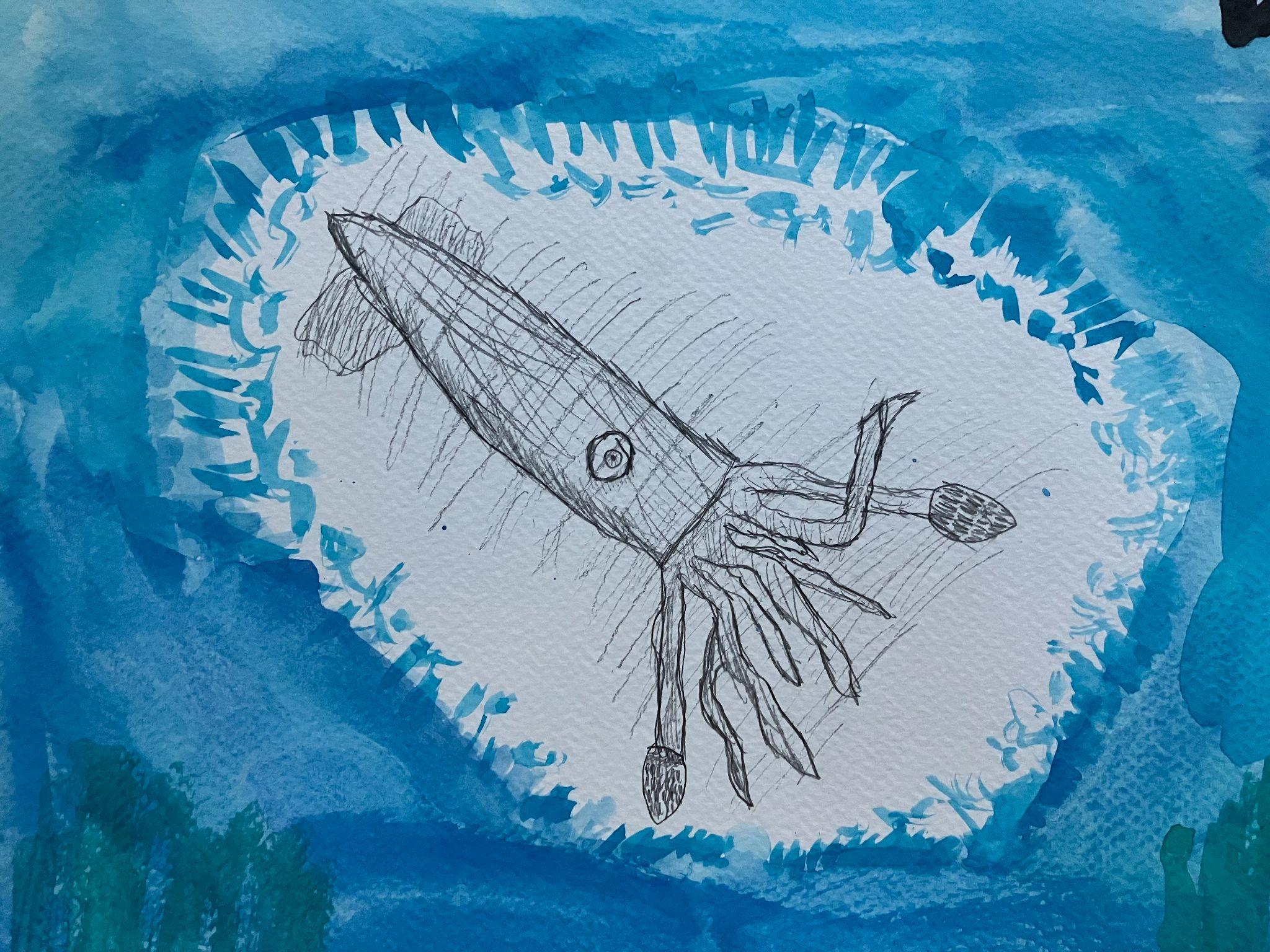
Pachyteuthis densus

  by Brody Dymond

The Pachyteuthis densus was the fossil of a belemnite found in the Upper Sundance formation in Buffalo, Wyoming. Belemnites were a type of squid that lived many years ago. 

Image of the Pachyteuthis densus study specimen.
Photo date 2024 by B. Dymond.

Belemnites evolved to have a different way of protecting themselves from other types of marine animals. They were fast swimmers! Instead of having an external shell, their shell was internal, which helped them speed through the water to escape from predators. The internal shell of a belemnite is the part that was fossilized. There are three parts of the internal shell: the pro-ostracum, the phragmocone, and the rostrum. 

A group of belemnites was called a battlefield. The average size of the belemnites when they were alive was 30 - 50 centimeters long. Belemnites could be found worldwide in shallow waters close to the shore. Belemnites ate small fish, other marine animals, and possibly other belemnites. 

The belemnite’s tentacles did not have suction cups like squid today. Instead, they had curved hooks. While squids today have eight arms, the belemnites had ten arms and on each arm were 30-50 curved hooks. They used the hooks on their arms to capture and eat small marine animals. While some squids today are the same size as belemnites, some squids can get much bigger. For example, Colossal Squid can get up to 14 meters (46 feet) long! 

The Belemnites went extinct at the end of the Cretaceous Period roughly 65.5 million years ago. They died around the same time as the dinosaurs.  


A concept of what Pachyteuthis densus looked like
when it was alive. Artwork by B. Dymond.


Thursday, May 30, 2024

Stylemys: A Fossil Tortoise from the White River Badlands

by Broden William Dymond

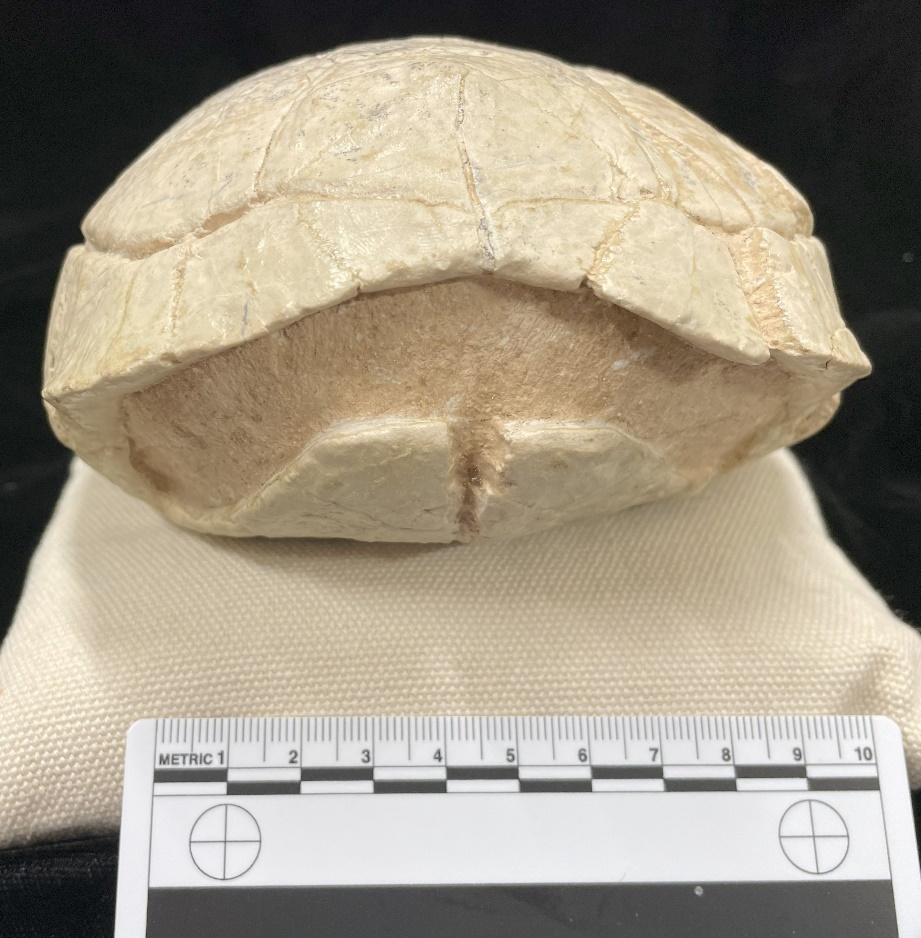
Stylemys was a tortoise that lived about 33 million years ago, during the Oligocene. Stylemys lived on land, rather than land and water. Fossils of Stylemys have been found in rocks in North Dakota, nearby states, Asia, and Europe. Stylemys was first described by Joseph Leidy, a fossil expert, in 1851. He was one of the important scientists in America at the time. This tortoise fossil was found in the Brule rock formation in the White River Badlands of South Dakota. 

Fossilized carapace of Stylemys nebrascensis.
Found in the White River area of North Dakota.
Photo by B. Dymond. From the collection of S. W. Veatch. 

During this Oligocene, North Dakota was a treeless plain covered in shrubs, plants, and some types of grass. It rained sometimes and the temperature was mild.

Stylemys had a domed carapace (upper shell) and a plastron (lower shell) for protection. Their limbs were made for living on land. Stylemys was similar to Gopher tortoises that are living today and they probably ate plants. The legs of Stylemys were different from Gopher tortoises so they probably did not dig tunnels. Turtles and tortoises at this stage in evolution survived well and have not changed much since that time.

The fossil of this Stylemys is slightly crushed with scratch marks near the tail and seems to have the mark from a tooth. Here is what might have happened to this Stylemys:

‘’One day, the tortoise was just walking along. He ate some grass just a little bit ago. He heard something behind him. It was a prehistoric crocodile! When the tortoise saw the crocodile, it started to run. The crocodile was faster, and it caught up to the tortoise. It bit and scratched the tortoise, but the tortoise fell into the mud. It was stuck so the predator could not get to it. The crocodile wanted the tortoise so bad but he noticed a sand storm coming and ran for safety. The end.”   It was from this comic:

Artwork by the author.

About the author:   Broden Dymond is an active Pebble Pup in the Grand Traverse Area Rock and Mineral Club. He is 10 years old and is in the 4th grade.


Friday, March 31, 2023

The Grand Traverse Area Rock and Mineral Club’s First Pebble Pup Class Meets in March

In recent years, there has been a growing interest in geology and rockhounding among people of all ages. Whether it's the thrill of finding a mineral, rock, or the satisfaction of identifying a fossil specimen, there's something about rockhounding that captures the imagination.

Nowhere is this more apparent than in a new rockhounding class for children, the Pebble Pups, which has been a smashing success. The class, which is taught by passionate and knowledgeable instructors, has attracted a wide range of students, from 5 years old to 16 years old, who are eager to learn about the fascinating world of geology.  Two groups comprise this program. Elementary students are Pebble Pups. Middle school students and high school students participate as Earth Science Scholars. The older students work on research projects and help work with the younger students.

The first class met March 15, 2023. There were 5 Pebble Pups, 2 teenage Earth Science Scholars, 3 parents, 3 pup teachers, and 3 adult visitors. The Pebble Pup classes cover a range of topics, from basic geology and mineral identification to more advanced concepts like plate tectonics and geological time. Through a combination of lectures, hands-on activities, and field trips, students are able to deepen their understanding of the subject and develop a love for rockhounding that will stay with them for years to come.

Melanie Ackerman and Steven Veatch begin the first Pebble Pup lesson.
Pebble Pups meet from 5: 30 to 6:10 pm, the same night
the club meets at the VFW. Photo by Shelly Veatch.

One of the reasons the class has been so successful is the enthusiasm and dedication of the instructors. With years of experience in the field, they are able to share their knowledge and passion for the subject with their students, making the class engaging and informative. The instructors are Steve Veatch, Melanie Ackerman, and Michelle Peters. Nathan Peters, who participates as an Earth Science Scholar, is the program assistant. 

Melanie Ackerman is teaching the group how to write a short poem a
bout a rock, or mineral, or even a fossil. This mixes writing with science
to produce something artful, a poem. April is National Poetry Month
and the pups will participate. Photo by Shelly Veatch.

Another factor contributing to the success of the class is the way it is structured. By combining traditional classroom learning with hands-on activities and field trips, students are able to experience the subject in a variety of ways and develop a deeper understanding of the material.

But perhaps the most significant factor in the success of the class is the students themselves. With their natural curiosity and willingness to learn, they have embraced the subject and are eager to explore the world of geology and rockhounding.

For these students, the class is more than just an opportunity to learn about rocks. It's a chance to connect with the natural world, to discover the beauty and complexity of the earth, and to develop a sense of wonder and appreciation for the world around them.

As the success of this new rockhounding class demonstrates, there is a growing interest in geology and rockhounding among young people. By providing them with the tools and knowledge to explore this fascinating subject, we are helping to cultivate the next generation of rockhounds, and that's something for the Grand Traverse Area Rock and Mineral Club to be proud of.


Unlocking the Secrets of Anyolite!

By Broden Dymond Have you ever seen a rock that looks like it has a ruby hidden inside it? If you have, you might have seen anyolite! Anyoli...